On this page
I own 8 board games — Monopoly, Exploding Kittens, Monopoly Deal, Game of Life, Herd Mentality, Piles, an RC Plane, and Jackstones. Games I bought, played a handful of times, and then watched sit on a shelf. So, mostly for fun, I built Unboxed: a small site where people in Metro Manila can rent them from me, pay via GCash, and get them delivered through Lalamove.
This post isn't about the code (that's Part 2). It's about the decisions that made this a real, working thing I could actually share instead of another idea that stayed half-built in a notes app — because those decisions mattered more than the tech stack did.
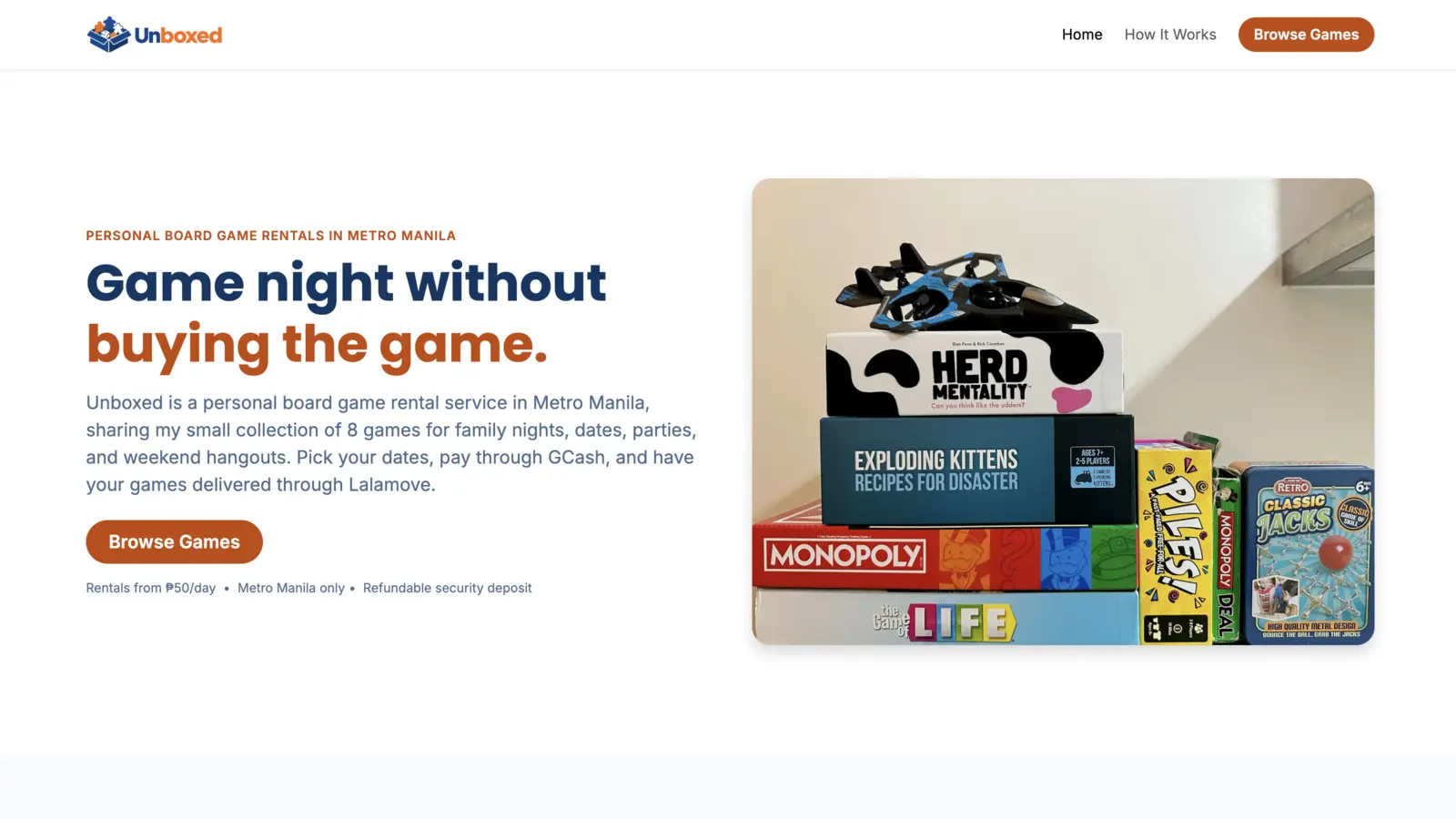
1. The Constraint That Shaped Everything: It's Just Me, Doing This for Fun
No team, no warehouse — 8 physical games and one person (me) coordinating delivery, checking payments, and answering messages by hand, in whatever spare time I have. Every decision below follows from that.
Payment is GCash, checked manually.
Someone pays the rental fee plus a refundable deposit, sends a
GCash reference number, and the booking sits as
pending until I personally confirm the money
actually landed. No payment gateway to integrate, no automated
reconciliation. For a handful of bookings a week, "I check my
GCash app" beats building and maintaining a payment
integration by a wide margin.
Delivery is Lalamove, coordinated by text. I arrange the delivery, the renter pays the Lalamove fee directly to the rider, and I text them once it's set. No delivery API — texting someone "Hi Alex! Your booking BG-1024 for September 20–22 is confirmed" is genuinely not a bottleneck at this scale.
A game is a game — one copy, one booking at a time. No inventory system, because there's nothing dynamic about 8 physical objects I can see on a shelf.
2. Policies That Stay Consistent Even Without Automation
Doing things by hand only works if the rules are still clear and applied the same way every time — the manual part can't turn into a "depends on my mood" part. So the policies are explicit, even though a person (me) enforces them:
- Full payment (rental + deposit) is required before a booking counts as confirmed — no "I'll pay when it arrives."
- The security deposit comes back after I inspect the return, with late fees, damage, or missing pieces deducted from it — never from the rental fee, which is non-refundable once confirmed.
- Cancelling is free before confirmation; once confirmed, only the deposit comes back if the games haven't shipped yet.
- A 10% discount kicks in automatically when someone books 2+ games — a small nudge toward exactly the kind of order that makes one delivery trip worth arranging.
None of that needs code to be true. It needs code to be shown consistently — which is really the site's job: computing the right numbers every time, not deciding the policy itself.
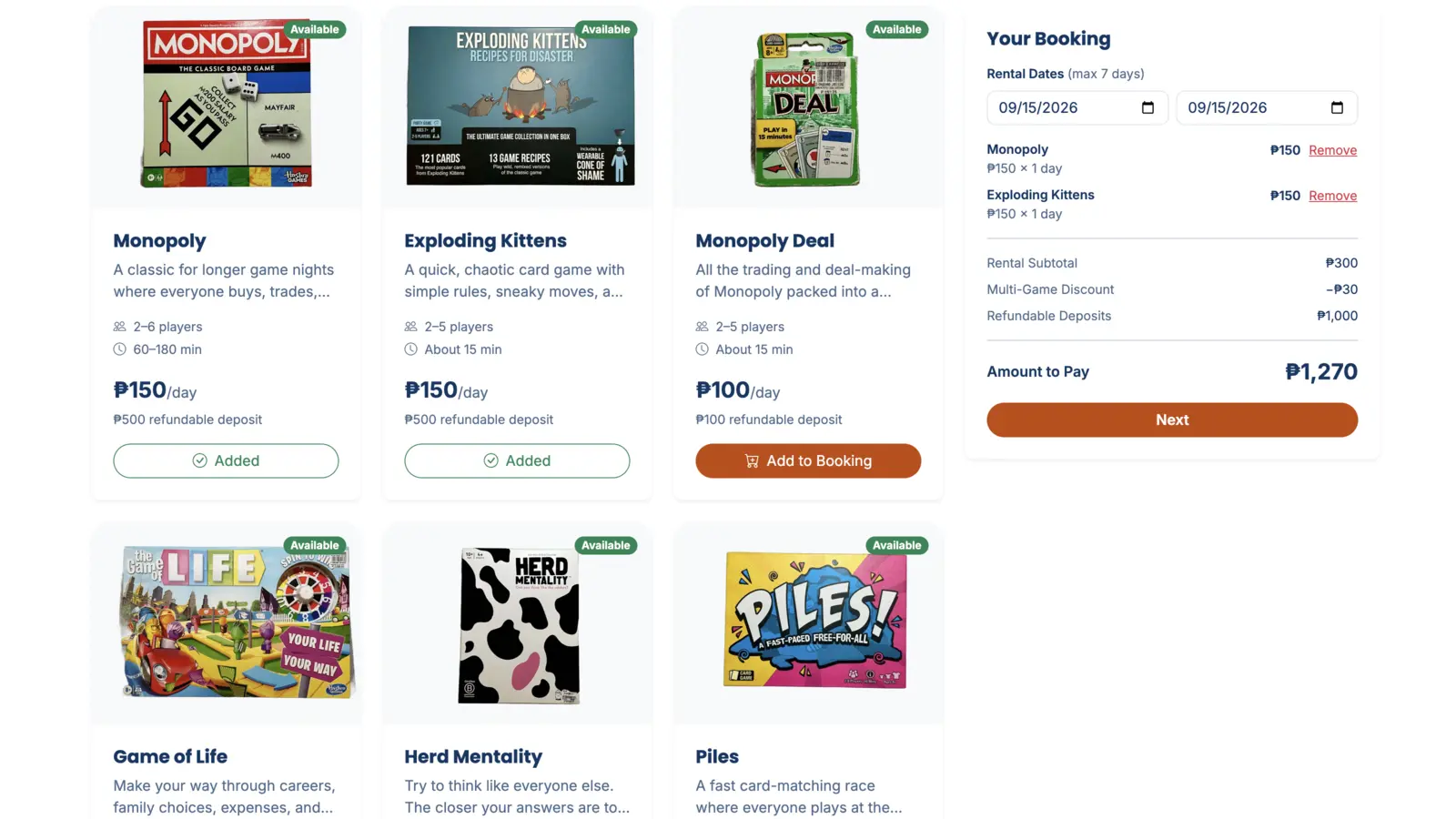
3. What the Website Is Actually Responsible For
Given how much of this is manual, it's fair to ask what the site even does. Three things, and it does them properly:
- Shows real availability. A booking that overlaps one I've already confirmed gets blocked automatically — nobody can double-book Monopoly, and I don't have to keep a mental calendar.
- Computes the real price. Rental days, the multi-game discount, the deposit total, the grand total — calculated from the actual per-game rates, not typed in by a renter or guessed by me.
- Only accepts deliveries inside Metro Manila. The one hard boundary of the whole idea (outside NCR, Lalamove coordination stops making sense) is caught at the address field, not discovered after someone's already paid.
Everything past that — confirming the payment actually arrived, deciding when a game is ready to hand off, inspecting it on return — stays with me, because I'm the one actually doing the renting-out.
4. Why I'm Sharing This Instead of Just Linking the Site
The easy way to lose momentum on something like this is over-building: a payment gateway integration for 8 games, a full admin dashboard for something I run alone, SMS automation for a few bookings a week. All real, all buildable, none of it necessary at this size — and exactly the kind of scope that turns a fun weekend project into one I never finish.
Deciding early which parts I was happy to keep manual — checking payments, coordinating delivery, inspecting returns — and which parts genuinely needed real logic — availability, pricing, the Metro Manila boundary — is the actual reason unboxed.liandrejohn.com is a real site I can point people to, instead of a repo I stopped touching. How it got built, and the tools I used to build it, are worth their own post — that's Part 2.